
Plasma Heating during Magnetic Reconnection
Plasma Heating during Magnetic Reconnection
Magnetic reconnection is a phenomenon where magnetic field changes its topology by reconnecting field lines and the magnetic energy is explosively released. Since it converts the released energy into various forms of energy, it is thought to be a mehanism for anomalous heating of the solar corona or non-thermal particle acceleration. However, it is not well understood how the released energy is distributed into plasma energies during magnetic reconnection.
Plasma heating is often observed to accompany magnetic reconnection in both astrophysical and laboratory plasmas. Specifically, the measured ion temperature often well exceeds the electron temperature. The fact that ions are selectively heated invalidates heating by the resistivity (Ohmic heating). The ohmic heating cannot be important because collsional effects are weak in many plasma environments.
Plasma Heating via Phase Mixing
In the weakly collisional plasmas, "phase mixing" provides a mechanism of converting energy from the fields to the particles in an irreversible way. Kinetic effects generally lead to non-Maxwellian distribution functions (deviation from thermal equilibrium). Since oscillatory structures created in velocity space quickly diffuse, the thermalization time scale may be comparable to the time scale of magnetic reconnection. Landau damping and finite Larmor radius effects are examples of kinetic effects which create small-scale structures in velocity space via phase mixing. Plasma heating due to phase mixing during magnetic reconnection has been confirmed by numerical simulations based on a kinetic model [1].
Simulation of Plasma Heating during Magnetic Reconnection
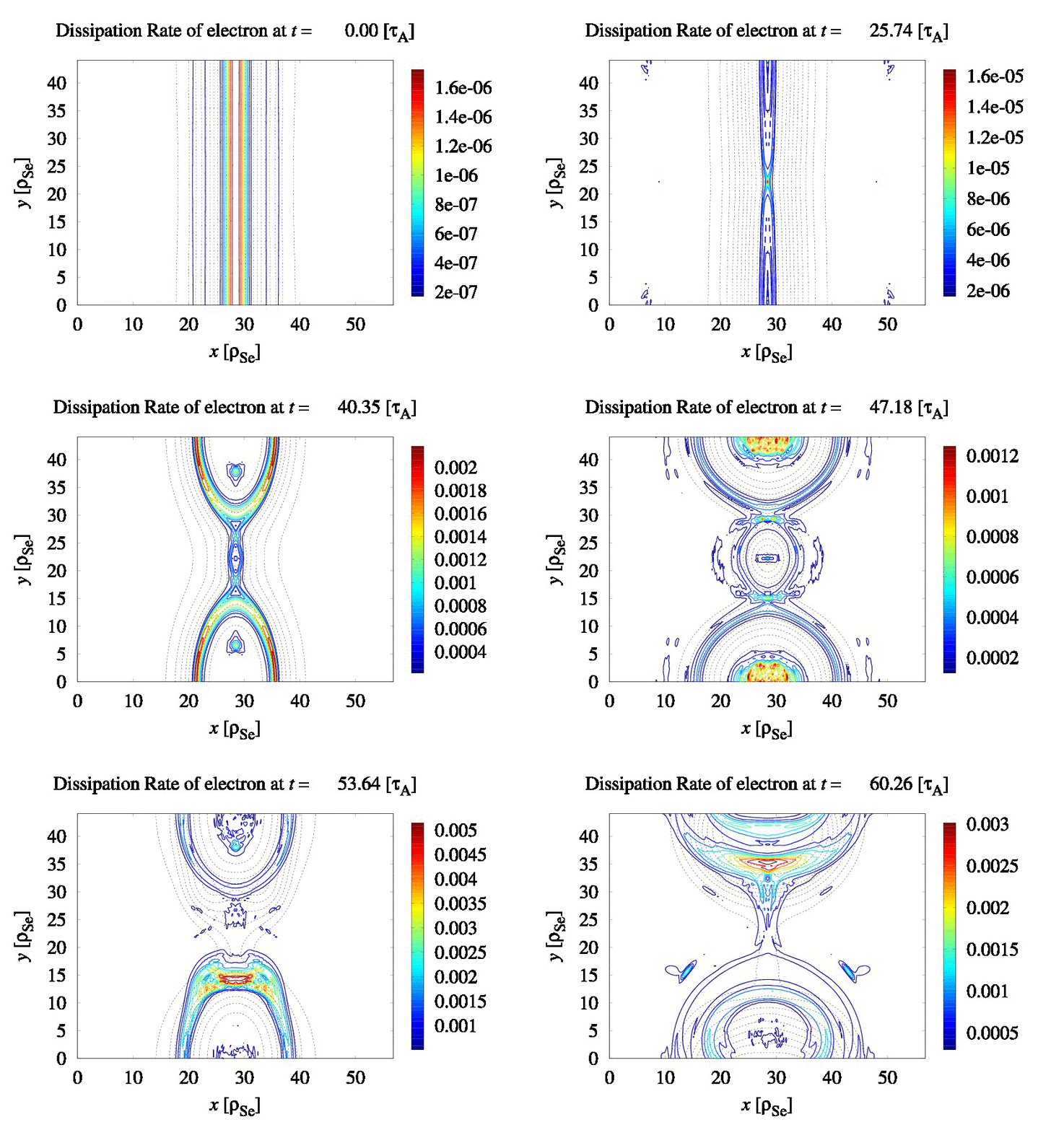
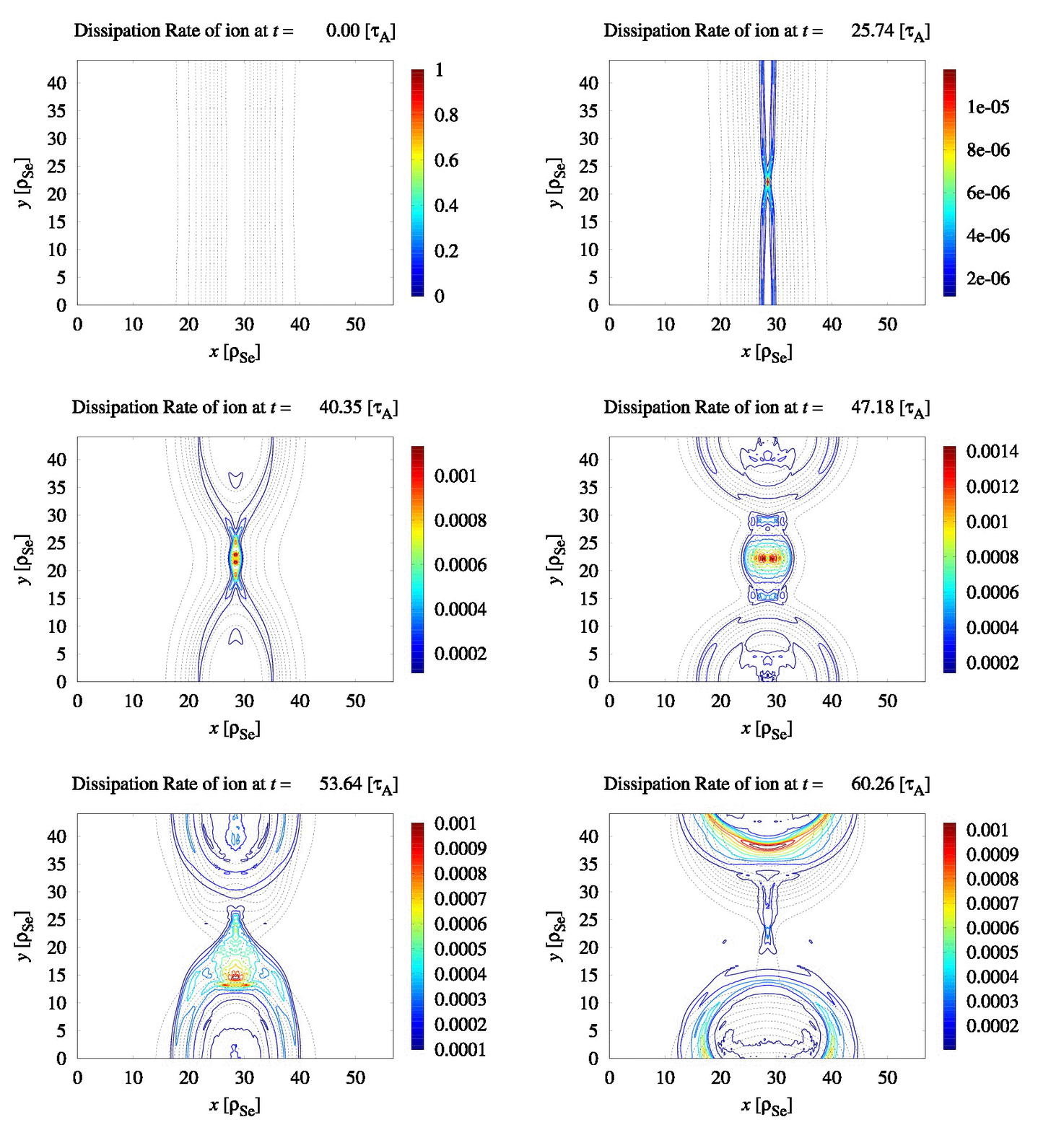
The movies below show the results of plasma heating obtained from nonlinear simulations of tearing mode magnetic reconnection based on the gyrokinetic model. By setting up an initial magnetic field which is unstable againt the tearing instability, small perturbation to it will exponentially grow to occur magnetic reconnection. Here "collisionless" simulations (collisionless means that the growth of the tearing instability or the magnetic reconnection rate do not depend on the collision frequency, but does not mean collisions are neglected.) are performed, so fast reconnection occurs due to electron kinetic effects. Colors in the figure indicate spatial distributions of dissipation=heating of electrons and ions. The background black lines are field lines. Initially, electron dissipapion dominates followed by the growth of ion dissipation as time goes, and eventually two dissipation rates become comparable. The electron heating occurs along the reconnected field lines, while ion heating is remarkable in the plasmoid generated at the reconnection point. These observations suggest that electron dissipation is caused mainly by linear Landau damping and ion dissipation is ascribed to nonlinear phase mixing due to finite Larmor radius effects.
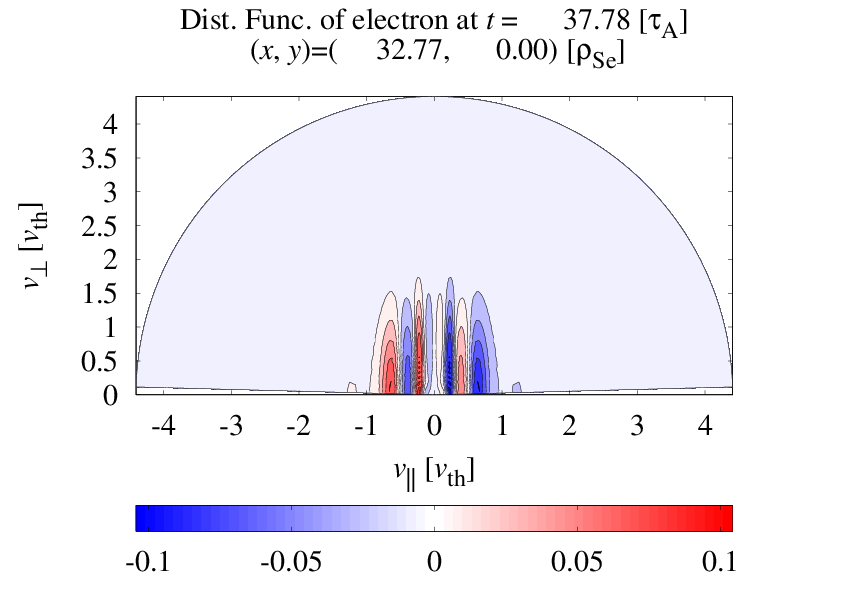
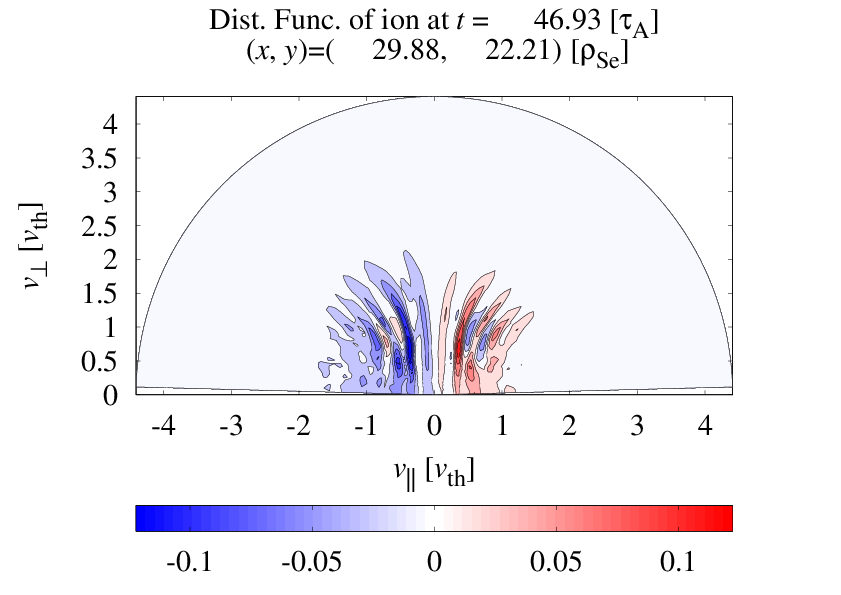
The occurrence of phase mixing and resultant heating as shown above can be clearly shown by seeing a velocity distribution function. Figures below show perturbations of ion and electron velocity distribution functions taken at specific time and position where heating is pronounced. (The total distribution function is a sum of this perturbation part and Maxwellean background.) The horizontal and vertial axes respectively denote velocity along and perpendicular to the magnetic field. Only an oscilatory structure along the magnetic field is seen in electron distribution function. This structure is typical to Landau damping. On the other hand, the perpendicular structure, as well as the parallel structure, is created in ion distribution function, which definitely proves that the nonlinear phase mixing leading to ion heating is effective during magnetic reconnection process.
[R. Numata and N. F. Loureiro, "Ion and electro heating during magnetic reconnection in weakly collisional plasmas", J. Plasma Phys. 81(2), 305810201, reproduced with permission.]
References
-
Ion and electron heating during magnetic reconnection in weakly collisional plasmas,
R. Numata, N. F. Loureiro Journal of Plasma Physics 81, 305810201 (2015).